Tuesday, May 15, 2007

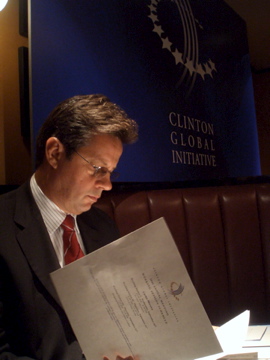
Clinton Global Initiative Commitment from WISekey


WISeKey is committed to providing the necessary identity management and transaction platform to enable a new approach of cash flow management to reduce operations costs, intermediaries and other sources which result in the loss of aid, remittances and micro-credit initiatives, as well as to increase the awareness and control capability of those providing the funds. WISeKey and the OISTE Foundation developed for this commitment the NETeID Social Network. The NETeID System was designed as a set of online tools intended to empower poor and excluded people around the world to access via their digital identities different sources of assistances and interventions. The system is designed to constitute a global social network that pulls data from all tools into one easy-to-manage web interface which will include a combination of digital identity, security, privacy, web access, blogging and remittances services. Enabling the poor to access the NETeID Social Network may bring them information and services to empower them to become confident, productive members of a healthy society. Full Commitment

Monday, April 16, 2007

Kofi Annan lance en septembre un forum humanitaire à Genève

Kofi Annan lance en septembre un forum humanitaire à Genève
| 21h47 - Cette nouvelle fondation internationale devrait fonctionner à la manière du WEF de Davos.
- Les décideurs du monde entier vont débarquer.


© Keystone | Kofi Annan. Il met son fabuleux carnet d’adresses au service de l’humanitaire.

Agrandir la taille du texte Réduire la taille du texte Imprimer l'article Envoyer par email Réagir sur l'article Recommander LINN LEVY | 15 Avril 2007 | 21h47
Le bruit courait depuis plusieurs mois. Depuis le jour où Kofi Annan, l’ancien secrétaire général de l’ONU, a choisi Genève pour passer une «retraite» active. Tout le monde connaît l’énergie déployée par le Ghanéen pour faire avancer la cause humanitaire, progresser la paix et le développement et réduire la pauvreté. Dans les milieux internationaux, on pariait que l’homme continuerait son combat en créant une fondation.

La chose a été confirmée hier par la NZZ am Sonntag. Kofi Annan va ouvrir un Forum humanitaire international (FHI) à Genève. Et ce, dès septembre. Le projet a, dès l’origine, reçu le soutien de la Confédération et bien sûr la collaboration de sa présidente Micheline Calmy-Rey, qui a fait de la promotion de la Genève internationale l’une des priorités de sa politique. «Le Département fédéral des affaires étrangères (DFAE) est en contact avec divers partenaires – institutions et personnes – concernant ce projet de nouvelle fondation installée à Genève, dévoile Jean-Philippe Jeannerat, chef de l’information du DFAE. L’institution, dans laquelle Kofi Annan va jouer un rôle central, œuvrera dans le domaine humanitaire sur le plan international.»

Le Davos humanitaire
Et le FHI fonctionnera vraisemblablement à la manière du World Economic Forum de Davos. Dès l’automne, c’est donc à Genève que les décideurs du monde entier vont façonner l’avenir de l’action humanitaire. Car Kofi Annan, maître dans l’art de la diplomatie et de la communication, possède un carnet d’adresses à faire pâlir Klaus Schwaab. Nul doute qu’il persuadera les puissants de se mettre au chevet du monde. Et la cité du bout du lac profitera des retombées, tant médiatiques qu’économiques, de ce Forum. «Personne ne s’étonnera que l’on fasse appel à Kofi Annan pour diriger cette fondation, explique Marie Heuzé, directrice de l’information de l’ONU. Son engagement et son expérience dans le domaine sont hors du commun.»

Les rencontres – on parle d’une grande réunion annuelle et de plusieurs petites sessions – se dérouleront donc au cœur de la Genève internationale. Le secrétariat permanent de l’institution s’installera, sans frais, dans la villa Rigot, propriété du canton située à deux pas de la place des Nations, abritant actuellement le Réseau universitaire international de Genève (RUIG). Le canton et la Confédération soutiennent donc le projet de concert. Pour quel montant? «S’agissant de l’engagement officiel de la Suisse, le Conseil fédéral devrait prendre les décisions dans le courant de l’année», précise Jean-Philippe Jeannerat.

Avec l’accueil du Forum de Kofi Annan, Genève confirme son statut de capitale des droits de l’homme, de l’humanitaire et de la paix.

Saturday, March 31, 2007

Vinton G. Cerf Vice President & Chief Internet Evangelist Google with Carlos Moreira Founder and President of WISekey


Vinton G. Cerf Vice President & Chief Internet Evangelist Google with Carlos Moreira Founder and President of WISekey and Patrick de Smedt, Chairman of WISekey Strategy Advisory Board and member of the Board at the ICANN's 28th Meeting.
Consultations meeting held at ICANN to discuss plans for WISekey to deploy digital identities to a broaden community. Carlos Moreira discussed with Vinton Cerf on his capacity as chairman of the board of the Internet Corporation for Assigned Names and Numbers (ICANN), WISekey’s and OISTE foundation plans to present to increase trust and security on the Internet by associating trusted Top Level Domains with strong identification and secure access. WISekey is deploying a global digital identification infartsructure enpowering users to move to transactional operations on the Internet.

WISekey is working with governments, NGOs, the Clinton Global Initiative
and International Organizations is committed to providing the necessary identity management and transaction platform to enable a new approach of cash flow management to reduce operations costs, intermediaries and other sources which result in the loss of aid, remittances and micro-credit initiatives, as well as to increase the awareness and control capability of those providing the funds. WISeKey and the OISTE Foundation developed for this commitment the NETeID Social Network. The NETeID System was designed as a set of online tools intended to empower poor and excluded people around the world to access via their digital identities different sources of assistances and interventions. The system is designed to constitute a global social network that pulls data from all tools into one easy-to-manage web interface which will include a combination of digital identity, security, privacy, web access, blogging and remittances services. Enabling the poor to access the NETeID Social Network may bring them information and services to empower them to become confident, productive members of a healthy society.

WISeKey, in cooperation with the International Organization for Secure Transactions Foundation (OISTE.org), will be providing a Digital Identification Infrastructure designed to support a network of 20,000 Identification Authorities worldwide with the objective to issue a billion digital identities. Each of these 20,000 Identification Authorities operating from 189 countries will be authorized to issue Digital Identities locally.

Sunday, January 21, 2007

“INCREASE TOURISM TO FIGHT POVERTY” -

“INCREASE TOURISM TO FIGHT POVERTY”

Madrid, 2 January 2007 - The World Tourism Organization (UNWTO) said today that 2007 should be a critical year to consolidate tourism as a key agent in the fight against poverty and a primary tool for sustainable development.

Against a projection of continuing worldwide growth in international tourism of more than 4% for international arrivals and revenues, Secretary-General Francesco Frangialli called for renewed effort to include sustainable tourism in the international development agenda, as a key tool to advance the Millennium Development Goals.

http://www.unwto.org/newsroom/Releases/2007/january/newyearmessage.htm

Sunday, January 07, 2007

Insurance for the Poor

Households in developing countries are exposed to high risks, with important consequences on their welfare. They range from individual-specific (illness, theft or unemployment), to economy-wide risks (drought, recession, etc.). It has long been acknowledged that these shocks have important implications, not least for the poor, including short-term effects on consump-tion and nutrition, resulting in calls for and the establishment of safety nets or other social secu-rity mechanisms. This paper goes beyond this view by arguing, first, that the costs related to these risks are much higher than a simple con-sideration of short-term costs, and secondly, that expanding insurance provision for the poor could be an important instrument with substan-tial long-term welfare benefits. Most impor-tantly, this paper discusses the scope and prob-lems related to the expansion of insurance mechanisms and products, with a focus on Latin America, starting from a consideration of how risk affects the poor and the ways in which they respond to it. The paper discusses the most promising products, institutional setup and the required regulatory framework to successfully expand insurance for the poor. http://www.iadb.org/sds/doc/Insurance_for_the_Poor.pdf

Monday, December 11, 2006

Carlos Moreira at the Poverty Alleviation RoundTable of the GCI


For many, globalization heralds the free movement of people, capital and ideas. But the benefits of globalization have yet to reach billions of people for whom economic mobility remains an aspiration rather than a reality. At a time of unprecedented wealth in many countries, three billion people survive on less than two dollars per day. In short, globalization is anything but global. The poverty working group at the Clinton Global Initiative seeks answers to these questions and concrete steps that people can take. Alleviating global poverty is not simply a matter of enlightened self-interest; it is, indeed, one of the greatest moral challenges of our time, and a necessary act of human solidarity.

Monday, November 13, 2006

 
WISeKey together with 15 other EU senior level executives exchanged views with Steve Ballmer, CEO of Microsoft as part of a Voices For Innovation event to foster European Entrepreneurship.

WISeKey continues its history of strong support to Voices for Innovation (VFI) by actively participating in events designed to increase the level and volume of the conversation around the technology policy debate. The latest event was a VFI Breakfast meeting with Steve Ballmer, CEO of Microsoft, and 15 other senior level executives from companies within Europe. Carlos Moreira and Dourgam Kummer, WISeKey’s Chairman and Managing Director, attended this exclusive breakfast as guests of VFI to the Executive Partner Summit in Cannes, France.

Lending their voices to the discussion, Moreira and Kummer helped drive the conversation around the need to increase the motivation of European innovators to start companies and to take risks in order to compete in the global marketplace. We need initiatives like Voices For Innovation to change the culture in Europe, on how we reward entrepreneurs.

Voices for Innovation is a global community, supported by Microsoft, that works to ensure the awareness and participation of local entrepreneurs and innovators in important policy discussions around the world. As a member of the Voices for Innovation community is the objective of WISekey to play an important role in shaping the technology policy debate and the regulatory environment in which you and fellow entrepreneurs operate in the EU . WISekey partners can visit and join the Voices for Innovation website which will help to keep informed of developments at both the European and national level. To ensure the continued success and relevance of the Voices for Innovation community, WISekey recommends you to join Voices for Innovation today. https://www.voicesforinnovation.org/TakeAction/Join%20Now.aspx and http://www.wisekey.com/info/news/wkjoinedvfi.htm Posted by Picasa

Tuesday, October 03, 2006

12.7 percent of U.S. households are "unbanked",

The 2001 Federal Reserve Board Survey of Consumer Finances estimates that around 12.7 percent of U.S. households are "unbanked", or not in possession of a checking account.

Therefore, almost 12 million households make up a definite block of the "bottom of the pyramid" in the U.S.. According to the Financial Service Centers of America (FiSCA) (the trade organization for check cashers) there are approximately 11,000 check cashing centers in the U.S.

These centers cash more than 180 million checks annually, at a total face value exceeding $55 billion. The check cashing charges range from one percent to 10 percent depending on the type of check (government, payroll, or personal), the amount of the check, and in some states, possession of proof of ID for the customer. Check cashing services in 18 states are unregulated. Frost & Sullivan estimates the size of the check cashing industry at approximately $2.5 billion.

The U.S. Department of the Treasury has designed an Electronic Transfer Account (ETA) in order to offer affordable services geared to match the financial habits of the un-banked population; The ETA eliminates the burden of depositing minimum funds to open an account, mitigates the strain of maintaining the average minimum balance, and protects against the common prospect of bounced checks and its associated charges. The ETA ensures that individuals who are required to receive federal payments electronically have access to an account at a reasonable cost (no more than $3 a month) and have the same consumer protections available as other account holders at the same financial institution. ETA is available at around 18,000 banking branches in the U.S.

The Unbanked Ecosystem


As Founder of WISeKey and the OISTE Foundation we already provided several major commitments to the United Nations International Telecommunication Union with a donation of 7 million dollars to deploy a digital identification system for developing countries http://www.itu.int/ITU-D/e-strategy/ecdc/ra/pdf/radeploy.pdf . WISeKey also launched a project with Microsoft at the World Summit on Information Society last year to Reduce the Gap in the New Digital Identification Divide by Issuing 20 Million Digital Identities at WSIS http://www.prnewswire.co.uk/cgi/news/release?id=158481.

After visiting the CGI and realized the unique collaborative development model that Clinton is putting in place, we are now decided to multiply this commitment by several times factor to the CGI so we can expand together the use of digital identification and true Single Sign-on functionality to over one billion people allowing them to securely transact chip to chip via the Internet to outreach the unbanked communities of the word. Financial institutions throughout the world have only recently begun to take notice of this "unbanked ecosystem". Because the majority of the unbanked are typically low-wage earners with few assets in disadvantages areas, Banks didn’t see much upside in pursuing their business. That attitude has to change as now teh Internet has the potential to reach every person in the world.

Monday, October 02, 2006

Carlos Moreira Blog Against Poverty - OutReaching the Unbanked

Carlos Moreira, is the Founder, chairman of the Board and Chief Executive of WISeKey Corporation, the fastest growing company in e-trust and e-security for personal, governmental and business computing. Carlos Moreira is Swiss and was born in Cadiz. He has over 20 years experience working with information systems for large multinationals, consulting groups, international organizations and the United Nations. Carlos has launched a Global Initiative to reduce poverty by provide digital identities and ebaking accounts to poor and disadvantage people many of them migrants to be used to channel them resources, including remittances.

Originally a former United Nations expert in Telecommunications, Security and Information Networks, Carlos Moreira has been responsible for research, development, implementation, analyses and negotiations related to technology, e-security and e-commerce for the United Nations and specialized agencies. He has focused in particular on the relationship between information technologies, security, telecommunications, and international trade networks. As World Technology Coordinator of the UNCTAD Trade Point Programme, he was responsible for the development of the world’s largest Internet Network of Mirror Sites and Secure hubs for for E-commerce (GTPNet). Visit Carlos Moreira Home Page